Emily Gilfillan Author
Emily is a Principal, architect and our Melbourne studio lead.
At the start of each project, a question that I often reflect on is, how do we build community?
At GroupGSA, this question sits quietly beneath every brief. It guides decisions across scale, typology, and discipline. Not as a fixed rule, but as a way of understanding how people genuinely connect.
Across high-rise living, purpose-built student accommodation (PBSA), aged care, social housing, and civic projects, we see community not as a single space, but as a network of relationships shaped by design.
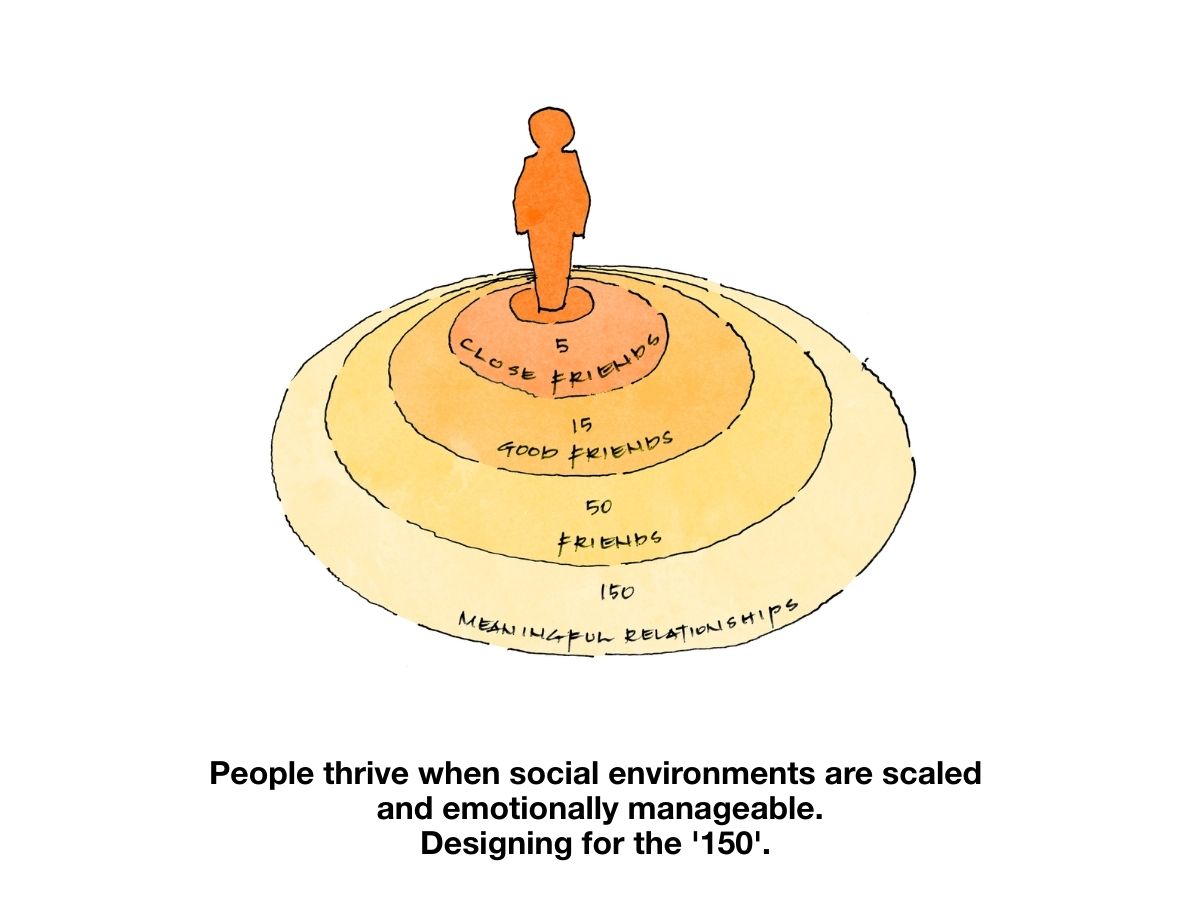
One of the frameworks that has informed our thinking, particularly in social housing and mixed tenure projects, is Dunbar’s theory. Proposed by anthropologist Robin Dunbar in the 1990s, it suggests that people can meaningfully keep around 150 stable social relationships. These relationships sit in layers, from a small inner circle of close support, through to broader but still recognisable social networks.
For us, the value of this theory is not the number itself. It is what it reveals about human capacity, time, and cognitive load. People thrive when social environments are scaled, legible and emotionally manageable. This insight has shaped how we design communities.
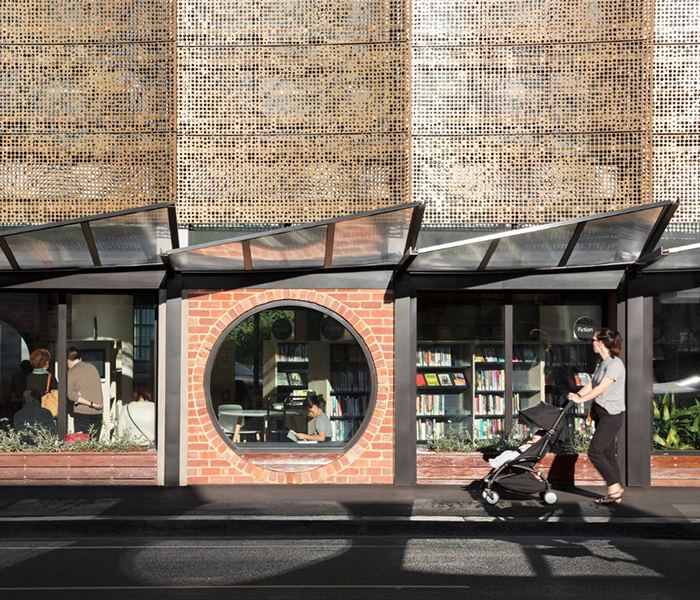
In all our projects, whether they are main market residential, aged care, public housing, PBSA; or our community hubs, rather than concentrating large numbers of people around singular, oversized communal spaces, we plan for smaller, identifiable spaces that support familiarity and trust. They allow people to recognise one another, build routine interactions, and form meaningful relationships over time. The shared spaces are distributed and layered to encourage exploration and engagement, and the more discrete and intimate settings support the closest circles of connection. Medium-sized communal areas allow for everyday social contact, and larger ones with shared amenities are provided, but never at the expense of clarity or comfort.
This approach is particularly important when we consider the neurodiverse brain. Our research highlights that not all people experience social environments in the same way. Overstimulating spaces, unclear thresholds and forced interaction can create stress rather than connection. By designing environments that offer choice, predictability and varied social intensity, we create places that are inclusive by design. This thinking only works because our disciplines operate as one.
At GroupGSA, our urban design, architecture, interior design and landscape architecture teams work as one integrated studio, shaping places around people, patterns of use and long-term change, not just buildings.
We begin by understanding who the place is for and how it will be used over time including movement patterns, cultural context, and social needs. We figure out how many people might share an entry, an external space, or street, by establishing scale, proximity, and the rhythm of daily encounters. This is developed through a deep understanding of site, history, and connection to Country. Creating places with identity, meaning and belonging, rather than generic outcomes.
This thinking is translated into and carried through the built form. We create meaningful environments that are legible and centred on the person. As such we break large master plans into smaller, identifiable neighbourhoods and clusters. This supports familiarity, safety, and social connection, which aligns to how people naturally form communities.

In designing buildings, we define thresholds, circulation, and spatial hierarchy, ensuring people can move comfortably between private, shared, and public life. With user experience front of mind, materiality, acoustics, lighting, furniture, and flexibility, are considered collectively, supporting ways in which people can engage or withdraw as needed.
In the public realm and outdoor spaces, planting and shared green spaces offer softer settings for connection, restoration, and informal interaction, providing balance. Through prioritising walkability, clear connections and high-quality public spaces we create spaces that invite people to linger, meet, and return.
Together, our multi-disciplinary approach allows us to design environments that respect cognitive limits, support wellbeing, and encourage genuine social bonds.
Whether in public or affordable housing, high-rise living, PBSA or community hubs, the principle remains the same. Community grows where people feel recognised, not overwhelmed. When design works with human behaviour, rather than against it, connection becomes natural and places become communities that last.
Through this approach, our team craft the built environment culminating in coherent, inclusive, and resilient spaces. Places where people can recognise themselves, connect with others and build community over time.
At GroupGSA we welcome the conversation as we continue our exploration in how design can better support connection across diverse communities.