Ideas & Insights
26 August 2026
Australia’s international education sector has spent years competing on the strength of its universities, research, lifestyle and global reputation. Protecting that position and the sector’s future growth now depends on where those students will live.
The need for universities to play a greater role in delivering student accommodation is not new. What has changed is the urgency. Government policy is increasingly connecting future international student growth with universities demonstrating a commitment to providing additional housing for their students.
If the capacity to grow an international student population becomes connected to the ability to house them, accommodation stops being a peripheral property issue. It becomes infrastructure supporting a university’s growth, competitiveness and global standing.
For years, enrolment strategy and accommodation strategy have largely operated on separate tracks. Universities recruited students, while much of the growth in purpose-built student accommodation was delivered by private providers. That separation is becoming harder to sustain.
The international student housing market is also changing. Students are not a single demographic with a single set of expectations. Some will prioritise location and affordability above everything else. Others are willing to pay more for privacy, services and amenity. Some will arrive with partners or children. Others may be looking for a highly social living environment; some will want somewhere quiet to retreat to after a day on campus.
The idea of a ‘typical’ international student is therefore becoming increasingly unhelpful.
A project our studio designed for postgraduate students at the University of Wollongong, for example, recognised that some residents would arrive with partners or young families. It was a relatively specific part of the accommodation offer, but it illustrates a broader point: housing works better when it starts with the people who will actually live there.
That sounds obvious, yet affordability and resident expectations are often treated as things to resolve after the basic development brief has been established.
There is an interesting lesson from the Netherlands, where a housing points system links characteristics such as floor area, energy performance and amenity with rental categories. Australia does not need to replicate the Dutch system to learn from the principle. What a student can afford should be an early design consideration, not a number tested against the project at the end.
For universities trying to accommodate increasingly diverse international cohorts, that could mean a mix of room types and price points, a broader accommodation portfolio or a deliberate affordable component.
The question is not simply how much accommodation can be built. It is who it will be accessible to.
The same shift in thinking applies to building performance. Students don't experience a Green Star rating or a Passivhaus certification. They experience whether their room is comfortable, whether they can sleep, whether the building is noisy, whether there is fresh air and whether the common areas feel like somewhere they actually want to spend time
At urbanest Battersea in London, the UK’s largest Passivhaus-certified PBSA development, performance is built into the architecture rather than treated as an engineering layer added afterwards. The outcome is not simply a certification. It is consistent temperatures, acoustic comfort and fresh air quality.
The technical response will inevitably be different in Australia, but the principle translates.
On a recent Newcastle student housing project our studio designed for UniLodge, targeting a 5 Star Green Star rating, every room was designed for natural cross-ventilation despite a busy street frontage. A large central garden became part of the environmental strategy, helping draw filtered air through the building.
Comfort, performance and running costs need to be considered as part of the architecture from the beginning. That matters to international students, but it also matters to universities as long-term owners and operators. A building that is expensive to run, difficult to maintain or uncomfortable to occupy can become an institutional liability long after the original development team has moved on.
More mature PBSA markets also recognise that student accommodation is part of the student experience, not simply somewhere to sleep.
At Canvas Wembley, communal spaces are organised around ideas including nature, social connection, mindfulness and sleep. It feels closer to a hospitality environment than a conventional student residence.
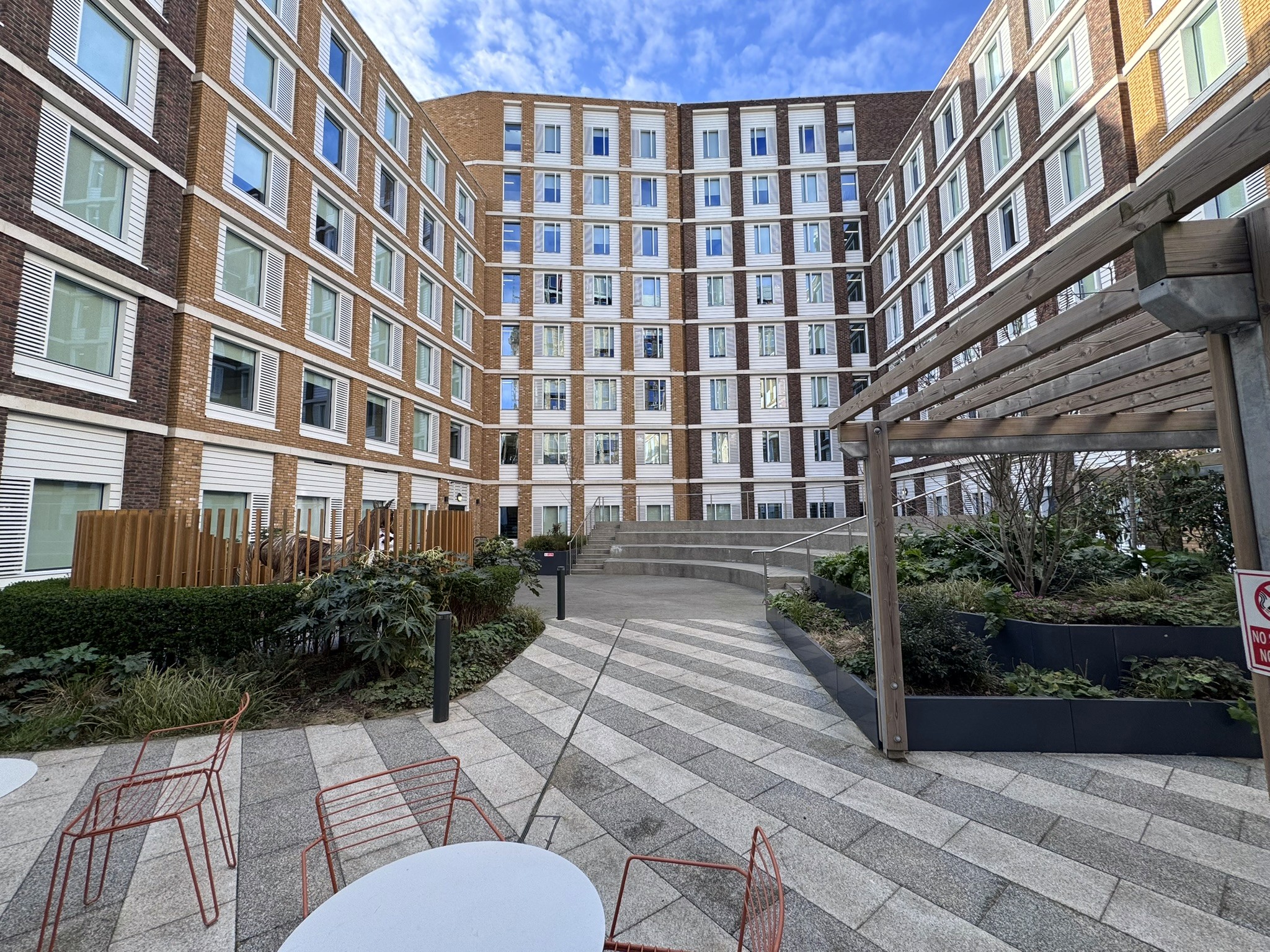
At Scape Canada Water, the thinking extends into the wider precinct, with landscape, movement and shared spaces contributing to a broader residential environment.
For a student arriving from another country, accommodation can be one of their first experiences of a university, a city and Australia itself. It can influence whether they feel connected, whether they meet people, whether they have somewhere to study and whether they have somewhere to retreat.
For universities, this means thinking about student housing at multiple scales: the room, the shared spaces and the campus around it. Good accommodation needs to offer choice rather than assuming every student wants the same level of activity or interaction.
Another challenge is time.
Universities operate according to academic calendars, not construction programmes. A delayed opening can mean missing an entire intake, disrupting campus operations or leaving an asset underutilised until the following academic year.
Amsterdam offers useful examples of how the repetitive nature of PBSA can be exploited through construction methodologies such as tunnel-form concrete used at OurDomain, where repetition becomes a programme advantage.
The same thinking can be applied through very different construction systems. On a recent Homes NSW project at Cowper Street in Glebe, our studio delivered an eight-storey cross-laminated timber building that was erected in as little as two weeks per floor, significantly faster than a comparable masonry structure. While it wasn’t student accommodation, the lesson transfers directly.
For universities facing pressure to increase housing supply, that connection between delivery, the academic calendar and student demand will become increasingly important.
Perhaps the most important lesson from Europe’s mature student accommodation markets isn’t about today’s students at all. It’s about tomorrow’s universities.
International student markets change. The countries students come from change. Their financial circumstances change. Their expectations change. Universities themselves change.
China remains Australia's largest international student source market, while growth from countries including Nepal and Bangladesh is changing the composition of the cohort. Over the life of a student accommodation building, those shifts can influence everything from affordability and room types to the balance between premium and value accommodation.
That makes adaptability less about whether a building has movable walls and more about whether it can continue to serve an institution and student population that won't stand still.
If housing capacity is linked to international student growth, then accommodation is part of the infrastructure that makes international education possible. It influences who can afford to study, what kind of experience students have once they arrive, how quickly universities can respond to demand and whether the buildings they invest in remain useful as their cohorts evolve.
The challenge isn’t simply to build more beds. It is to understand who those beds are for, how they should perform, how they can be delivered within the rhythms of a university, what kind of student experience surrounds them and whether they will remain relevant as the institution changes.
London and Amsterdam demonstrate that successful student accommodation isn’t the product of one clever design idea. It is the outcome of strategic decisions made long before construction starts.
For universities, that means the decisions made before the first room is designed may prove every bit as important as the building itself.
It starts with a better brief.
Image: Scape Canada Waters / Alister Eden
Originally published on Campus Review




Nominated Architect:
Lisa-Maree Carrigan NSW ARB 7568


